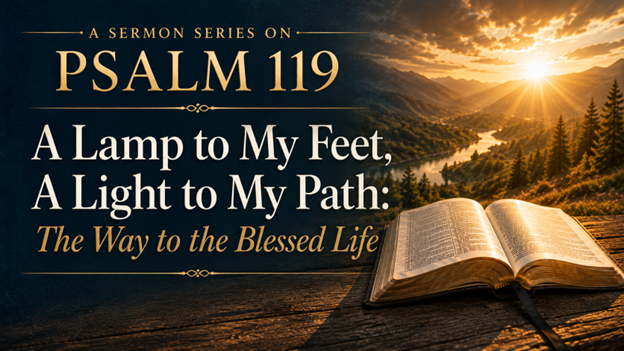
The Guarded Life is a Word-Shaped Life
The Guarded Life - Psalm 119-9-16
Dear CG leaders, here is the outline for the Bet section of Psalm 119. There is no TRAP daily devotion for you at the end of the outline since the Psalm 119 daily devotion uses the TRAP method and I hope you are daily reading those. The goal is for God to Colossians 3:16 our lives. Ha. Did you notice that? I just used Colossians 3:16 as a verb. But that’s what the psalmist is talking about in Psalm 119; a Word-saturated life that leads us to and creates in us, ‘the
blessed life.’
Remember, I wrote 68 daily devotions and then started over as the template developed. In other words, it took 68 devotions to arrive at a blueprint I was satisfied with. So, I’m not above/beyond changing the template as we go along. If you have any advice, any at all, please text, e-mail or call me. I am praying and fasting that God will grant our congregation a passion for his Word and that the Word will truly transform our lives, giving us Word-centered, blessed lives. This is an important 176 days in the life of Heritage; in your life and mine.
At the end of this note is a description of the TRAP blueprint, i.e., the who, what, why, when and how of the daily devotions. I hope understanding what each section of the devotion is intended to do will make them come more alive for you. I’ll probably post that explanation on the website/app for our congregation to read also. Well, here we are, in the Bet section of Psalm 119.
The Guarded Life is a Word-Shaped Life
Psalm 119:9–16
Introduction: The Bet section begins with a question about purity and unfolds into a picture of a life guarded, directed, filled, spoken, delighted in, and remembered through God’s Word.
First: The Word Guards the Way of Life (9–10)
The psalmist begins with the vulnerability of the young man and the danger of wandering.
“Prone to wander, Lord, I feel it.” That’s natural to all of us.
And yet, we can live pure lives with whole-life purity guarded according to God’s Word as we seek God whole-heartedly. (The divided life vs the whole life is a major theme in this psalm).
Second: The Word Forms the Hidden Life of the Heart (11–12)
The Word must be stored in the heart before it shapes the life. Not just read. Internalized. Not just internalized. Lived out.
As the psalmist treasures God’s Word inwardly it creates a worshipping life, a life wholly centered on God.
Third: The Word Overflows into Speech, Delight, and Meditation (13–15)
Notice the movement. What fills the heart eventually reaches the lips, reshapes desire, and commands our attention.
The psalmist declares, delights, meditates, and fixes his eyes on the ways of God.
Fourth: The Word Produces Remembering Delight (16)
The stanza/section ends with delight and remembrance held together.
The Word that becomes the joy of the heart is the Word the heart refuses to forget, cannot forget, any more than we could forget to breathe. It’s a Coram Deo life.
Fifth: This Is Where the Gospel Meets Us
The Father demands wholehearted living. But who can deliver us from this body of death? (Ro 7:24). We are born dead and can only sin? Who can live this life of perfect righteousness, of perfect holiness, of perfect blessedness? That is the cry of our hearts. The answer is, Jesus.
That’s Who.
Jesus is the perfectly pure, whole-hearted, Word-filled Son who treasured, declared, delighted in, meditated on, and never forgot the Father’s Word. He not only did this but credits his doing of it to us.
And by His Spirit, He now forms that same Word-guarded life in us.
Conclusion
The guarded life is not created by willpower but formed by God’s Word. Bet calls us to guard our way, seek God wholly, store His Word deeply, speak it openly, delight in it richly, meditate on it steadily, and remember it faithfully. That creates a worshipping life.
The Blueprint for the Psalm 119 TRAP Daily Devotions
The TRAP devotions are intentionally written in a particular way. They are not simply short Bible readings or inspirational thoughts for the day. They are designed to help us slowly live inside the text of the Bible and for the Bible to live inside us, giving God time to shape/form us by his Word. As the psalmist says, it is a way, a journey, a pilgrimage, from conversion to glory. And all along the way, the Bible instructs us in living the blessed life. Psalm 119 itself teaches us that spiritual formation happens through sustained, not sporadic, but whole-heart, steadfast, fixed attention to and keeping of God’s Word (those 3 terms come from verses 1-8).
That is why the Psalm, and these devotions move slowly, repeat themes intentionally, and continually return to the Word as God’s soul-shaping gift to us. The goal is not speed, but transformation. But if you will give the Bible enough time, it will change your life.
As you may already know, TRAP stands for Think, Reflect, Apply, and Pray.
The “Think” section asks, “What does this passage say?” This is where we pay careful attention to the actual words of the text. We look at key phrases, repeated ideas, and important biblical terms. Often Hebrew words are included because the language itself sometimes carries shades of meaning that deepen our understanding of the verse. This section is meant to help us slow down and actually see what God has spoken instead of rushing past the passage too quickly. The goal is not academic information alone, but careful observation rooted in the text itself.
The “Reflect” section asks, “What does this passage mean?” Here the devotion begins pressing the truth of the text into ordinary human life. Reflection connects the Bible to our fears, desires, struggles, temptations, habits, relationships, and patterns of thinking. This section is
designed to help us think honestly about ourselves beneath the authority of God’s Word.
Within the “Reflect” section, there is always a deliberate movement called, “This is where the gospel meets us.” That section is essential because the Christian life is not built on moral pressure or self-improvement. The Father commands holiness, purity, faithfulness,
obedience, and love because those things reflect His character and wisdom. They are best for us and God knows it. But the Bible also teaches that we cannot produce that life perfectly ourselves. Jesus lived the life we were commanded to live but have failed to live. His righteousness is credited to us through faith, giving us a right standing before God and the assurance of salvation.
Then the Holy Spirit begins forming the life of Christ within us. This is the “good” of Romans 8:28-29. In other words, Jesus is apex of blessed and his life is ours by grace. This means the devotions are intentionally gospel-centered: identity-rooted, grace-driven, Christ-conforming and Spirit-dependent. The “gospel meets us” section keeps the devotion from becoming moralistic, guilt-driven, or merely behavior-focused.
You will also notice the recurring phrase, “So think about this…” That sentence functions as a pastoral pressure point. It slows you down and presses the truth of the passage inward personally. It is designed to move the devotion from general reflection into direct heart examination. In many ways, it functions like the moment in a sermon when the truth begins asking questions of us personally. It intentionally forces us to stop, think, and wrestle honestly with the implications of the text. The goal is not condemnation, but clarity and conviction beneath the Word of God.
The “Apply” section asks, “How should this change my life?” Application is where truth moves toward action. It makes us FIT believers (Faith In Action). But biblical application is not merely behavior management. It is surrender. Ahhh, there’s the Shakespearean ‘rub.’ It is learning to place actual areas of our life beneath the authority of God’s Word. That is why the applications are usually specific and concrete. The goal is not vague inspiration but real obedience flowing from faith and by grace. Over time, repeated obedience begins reshaping the heart itself. What once felt unnatural slowly becomes part of the way we live. Ultimately, we find ourselves living supernatural lives, lives different from when we lived subservient to the flesh or the world around us.
Then, near the end of the “Apply” section, you will usually see the phrase, “And
remember this…” That sentence serves a different function. If “So think about this…” presses truth inward, “And remember this…” anchors truth deeply. It is meant to leave you with a memorable, stabilizing summary statement to carry into the day. These statements often summarize the central spiritual reality of the devotion in a concise and pastoral way. They are
designed to linger in the mind after the devotion itself is finished. Don’t just read that line instead of the devotion. If you do, you’ll miss the point of Psalm 119 which is life transformation by sustained, slow, thoughtful, wresting even, interaction with the Bible.
Finally, the “Pray” section reminds us that transformation is ultimately the work of God. The prayers are intentionally Trinitarian. We pray to the Father because He is the source of truth, wisdom, holiness, and life. And, he has commanded the life we want and need to live, but cannot. We also pray for the Holy Spirit to open our eyes to understand the Bible, convict us of sin, strengthen us in weakness, reshape our desires, while forming the life of Christ within us.
The Christian life is not self-improvement. It is a supernatural life and can’t be lived in the flesh. Trying to live without the Holy Spirit’s enabling only results in frustration, anger, and quitting. We need the Holy Spirit – the Spirit of Jesus – to reproduce the character of Jesus within us through the Word of God. So, we pray for the Holy Spirit to do within us what we cannot do for ourselves, but what we need done the most. Then, we conclude the prayer praying through Jesus (like praying in Jesus’ name) because His perfect life, death, and resurrection are the foundation of our acceptance before God and our ability to live the Christian life. The cross is our only hope for blessedness. It has taken us out of the acidic, soul-murdering soil of the world and
transplanted us in fertile soil able to grow the blessed life. PS. That section is just a suggestion
for how to pray. Don’t let it replace your prayers.
Well, that’s it. Taken together, the TRAP model is designed to move us from information to meditation, from meditation to transformation, and from transformation to worshipful dependence upon God. This is a life lived Coram Deo, before the face of God, moment-by- moment. The hope is not merely that we would finish these devotions, but that over time God would use them to form in us a Bible-shaped life, which is synonymous with the blessed life.
As you go through these devotions, if you have any questions or insight, please reach out to me. I need your help making these devotions be the best they can be for Heritage.